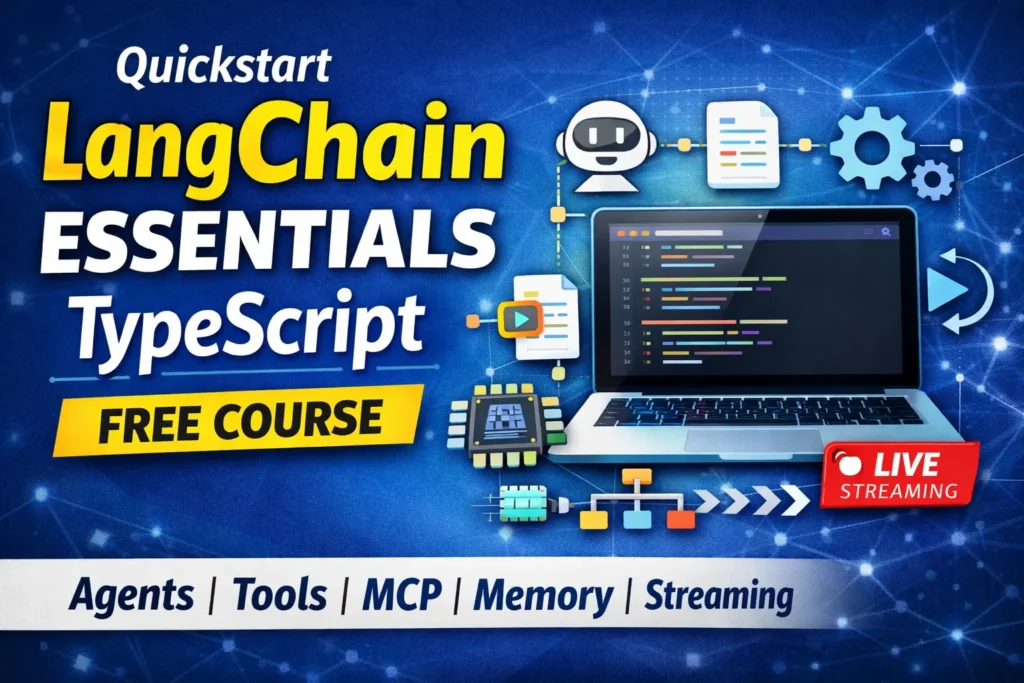
Quickstart: LangChain Essentials – TypeScript Review and Guide for Developers
Published for developers looking for a free LangChain TypeScript course and a fast way to understand modern AI application building.
If you want to learn LangChain with TypeScript without paying for a beginner course, Quickstart: LangChain Essentials – TypeScript from LangChain Academy is one of the most direct starting points available. The course is presented as a free program that introduces the core elements of LangChain and focuses on practical concepts such as create_agent, messages, tools, MCP, streaming, memory, structured output, dynamic prompting, and human-in-the-loop workflows.
For developers, this makes the course especially attractive. Instead of spending time on abstract theory, the course appears designed to help learners quickly understand the core building blocks required to build real AI applications in TypeScript. It is short, focused, and positioned as a quickstart rather than an overwhelming multi-week training path.
At a glance:
- Course Name: Quickstart: LangChain Essentials – TypeScript
- Platform: LangChain Academy
- Price: Free
- Total Lessons: 17
- Video Content: About 0.5 hours
What Is Quickstart: LangChain Essentials – TypeScript?
Quickstart: LangChain Essentials – TypeScript is a compact introductory course hosted by LangChain Academy. Its purpose is to teach the essential foundations of LangChain in a TypeScript environment. The course page highlights that learners will explore the core framework concepts and learn how to build with create_agent, described as a powerful and extensible agent building block.
The course also lists several practical topics that matter in real AI development, including messages, streaming, tools, MCP, memory, structured outputs, dynamic prompts, and human review workflows. This tells us that the course is not just about prompting a model. It is about understanding how to build structured, useful, and interactive AI systems.
That positioning is important because many developers today are not just experimenting with AI. They are building chat interfaces, SaaS assistants, automation pipelines, internal copilots, lead qualification bots, support workflows, and task-specific agent systems. For those use cases, a course that focuses on the operational building blocks of LangChain is far more useful than a generic LLM overview.
Why This Free LangChain TypeScript Course Matters
TypeScript has become one of the most important languages for modern application development. It is used across Node.js backends, React and Next.js frontends, serverless functions, API layers, workflow automation, and SaaS products. As a result, developers increasingly want AI tooling that fits naturally into the TypeScript ecosystem.
This is where a course like Quickstart: LangChain Essentials – TypeScript becomes valuable. Rather than forcing developers to learn from Python-first examples and mentally translate concepts into their own stack, this course directly addresses the TypeScript workflow. That reduces friction, speeds up implementation, and makes the learning path more relevant for JavaScript and TypeScript developers.
The listed lessons show that the course is designed around real application concerns. Topics such as tools, memory, streaming, and structured output are not “nice to have” concepts. They are often the difference between a toy demo and a usable AI product.
Course Structure and Format
According to the course page, the program contains 17 lessons and about 0.5 hours of video content. That means the course is intentionally short and likely designed for speed and clarity rather than exhaustive depth.
For many developers, this is actually a strength. A short course lowers the barrier to entry. You can complete it quickly, get familiar with the terminology and core patterns, and then move on to applying what you learned in your own projects.
The course page also shows that learners can enroll for free and access additional learning resources such as:
- Overview
- Getting Set Up
- Getting Started Video
- Forum and Slack Community
- Course Slides
- Course Transcripts
This is useful because support materials often make a huge difference in technical learning. Slides help with quick review, transcripts help with skimming and referencing, and community access can be helpful when you get stuck or want clarification.
Full Curriculum Breakdown
The main course flow listed on the page includes the following lessons:
- Create Agent
- Models and Messages
- Streaming
- Tools
- Tools with MCP
- Memory
- Structured Output
- Dynamic Prompt
- Human in the Loop
- Conclusion
- Course Feedback
This sequence is well designed because it starts with the basic agent concept, then builds outward into the main pieces required for interactive and useful LLM systems. It follows a practical learning order that most developers can understand quickly.
What Each Lesson Appears to Teach
1. Create Agent
This lesson likely introduces the core method of setting up an agent with LangChain. Since the course description specifically calls out create_agent, this seems to be the foundation of the whole training. It is probably where learners first understand how LangChain structures agent-based applications.
2. Models and Messages
This topic is crucial because modern LLM systems rely on structured message input rather than plain text alone. Understanding how models receive user, system, and assistant messages is fundamental to building reliable conversational applications.
3. Streaming
Streaming allows AI responses to appear progressively rather than all at once. This improves responsiveness and user experience, especially in chat interfaces, assistants, and real-time applications.
4. Tools
Tools let an AI system do more than generate text. With tools, a model can trigger functions, retrieve information, or connect with external services. This is a major step toward building practical AI agents.
5. Tools with MCP
The inclusion of a dedicated lesson on MCP suggests the course goes beyond basic tool calling and touches on a more extensible architecture for model-context interactions and integrations.
6. Memory
Memory is essential when you want your AI system to retain useful context across multiple turns. This matters for assistants, customer support bots, internal copilots, and any workflow where continuity is important.
7. Structured Output
Structured output is one of the most valuable concepts in applied AI development. Free-form text is helpful for human reading, but applications often need predictable outputs such as objects, fields, or validated formats that other parts of a system can use safely.
8. Dynamic Prompt
Dynamic prompts allow developers to assemble prompts based on variables, user context, logic, or workflow state. This is much more useful than relying only on hard-coded static prompts.
9. Human in the Loop
Human oversight is critical in real-world deployments. When an AI system may affect business decisions, customer communication, or sensitive actions, review and approval steps can improve reliability and reduce risk.
Who Should Take This Course?
This course seems especially useful for:
- Beginner developers who want to learn LangChain with TypeScript
- JavaScript and TypeScript engineers building AI products
- Startup founders and indie hackers creating AI-powered tools
- Automation builders who want to understand agents, tools, and memory
- Developers looking for a free and fast LangChain learning resource
If you are already comfortable with TypeScript and want to start building with LangChain without spending days on documentation first, this course looks like an efficient entry point.
Main Strengths of the Course
It Is Free
Cost matters, especially for students, early-stage builders, and self-learners. A free course removes the biggest barrier to getting started and makes it easier to explore the framework before committing to deeper learning.
It Focuses on Essentials
The course branding is clear. It is a quickstart that teaches the essential LangChain concepts rather than trying to be an everything course. That makes it practical and approachable.
It Covers Real Development Topics
The curriculum is aligned with real use cases. Topics like structured output, memory, tools, and human in the loop are directly relevant to production-minded developers.
It Is Short and Accessible
With only around 30 minutes of video content, this course is easy to fit into a busy schedule. That makes it much more likely that learners will actually finish it.
It Includes Extra Learning Resources
Slides, transcripts, setup materials, and community access improve the learning experience and make the course easier to revisit later.
Potential Limitations to Keep in Mind
Because the course is short, it is best viewed as an introduction rather than a complete mastery path. Developers who want deep implementation detail, advanced orchestration patterns, large production architectures, or domain-specific examples will probably need additional study after finishing it.
Still, that is not really a flaw. It simply reflects the course’s purpose. A quickstart is meant to give you a solid base, not replace all future documentation, experimentation, and project work.
Is It Worth Taking?
Yes, for the right audience, it appears absolutely worth taking. If your goal is to understand the core LangChain concepts in TypeScript and start building AI applications faster, this course looks like a strong entry point.
The biggest reasons are simple: it is free, focused, short, practical, and aligned with the real building blocks used in modern AI systems. It is especially suitable for developers who prefer learning by understanding a framework’s core primitives first and then applying them in real projects.
Final Verdict
Quickstart: LangChain Essentials – TypeScript looks like a strong free starting point for developers who want to learn LangChain in a TypeScript environment. The course is built around practical topics such as create_agent, messages, streaming, tools, MCP, memory, structured outputs, dynamic prompts, and human-in-the-loop design. With 17 lessons and about 0.5 hours of video content, it is positioned as a fast and efficient learning resource rather than a long-form training program.
For anyone searching for a free LangChain TypeScript course, a LangChain Academy quickstart, or a beginner-friendly LangChain guide for developers, this course appears to be a valuable first step. It gives learners the vocabulary, concepts, and framework orientation needed to move into hands-on building with more confidence.
If your goal is to get productive quickly and understand what matters most in LangChain development, this course is a smart place to begin.
Frequently Asked Questions
Is Quickstart: LangChain Essentials – TypeScript free?
Yes. The course page presents it as a free course on LangChain Academy.
How many lessons are included?
The course page lists 17 lessons.
How long is the course?
The course page states that it includes about 0.5 hours of video content.
What topics does the course cover?
It covers create_agent, models and messages, streaming, tools, tools with MCP, memory, structured output, dynamic prompts, and human in the loop.
Who is this course best for?
It is best for developers, TypeScript builders, and beginners who want a practical introduction to LangChain.
Official course page: Quickstart: LangChain Essentials – TypeScript