Agentic AI : Complete Course Review, Syllabus, and Why It Matters
A blog-style review for developers, AI builders, and professionals who want to understand whether the Agentic AI course by DeepLearning.AI is worth taking.
If you want to move beyond prompt engineering and learn how to build AI systems that can reason through tasks, use tools, plan workflows, and coordinate multiple agents, the Agentic AI course from DeepLearning.AI is one of the most relevant options available right now. Taught by Andrew Ng, this course is designed for learners who want a practical introduction to agentic workflows and how they can be applied in modern software systems.
Agentic AI is becoming one of the most important ideas in applied artificial intelligence. Businesses and developers are no longer looking only for chatbots that answer questions. They want systems that can execute multi-step tasks, call APIs, evaluate their own outputs, work with tools, and solve more complex problems with greater autonomy. That is exactly the direction this course takes.
In this article, we will break down what the course covers, who it is for, the main design patterns it teaches, the full module structure, and whether it is worth your time if you are serious about building AI-powered workflows.
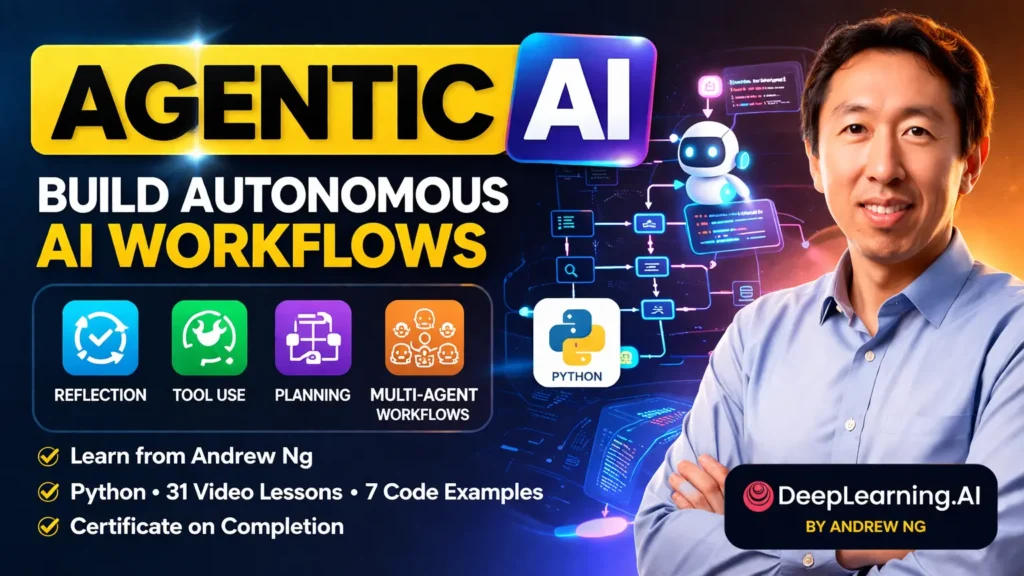
Course snapshot:
- Course: Agentic AI
- Platform: DeepLearning.AI
- Instructor: Andrew Ng
- Level: Intermediate
- Duration: 5 hours 54 minutes
- Content: 31 video lessons and 7 code examples
- Language used: Python
- Completion: Certificate available
What Is the Agentic AI Course?
The Agentic AI course is a structured learning program from DeepLearning.AI that teaches how to build AI systems capable of handling multi-step, iterative, tool-using workflows. Instead of treating AI as a single-response engine, this course focuses on designing software systems where large language models can reason through tasks, reflect on results, interact with tools, and coordinate more complex actions.
This distinction is important. A regular AI tutorial may teach you how to write better prompts or build a simple chatbot. An agentic AI course, by contrast, teaches you how to create systems that behave more like problem-solving entities. These systems can decompose tasks, check outputs, call external services, and adapt when something goes wrong.
That is why agentic AI has become such a hot topic in product development, SaaS automation, enterprise AI, research workflows, and intelligent assistants. It offers a more practical path toward software that can do work, not just talk about it.
Why Agentic AI Matters So Much Today
Modern AI products increasingly need to do more than generate text. In real-world settings, AI systems must often:
- Gather data from external systems
- Plan a sequence of steps
- Execute tasks in order
- Check whether the result is correct
- Retry or refine outputs when necessary
- Work across multiple specialized components
This is what makes agentic AI different from one-shot prompting. It treats AI as part of a broader workflow architecture. Instead of saying “give me an answer,” you design a system that can think through the process, use the right tools, and adjust based on intermediate results.
That is also why this course feels timely. It focuses on the practical design patterns behind intelligent workflows rather than only discussing AI at a conceptual or hype-driven level.
What You Will Learn in This Course
The course is centered around four major agentic design patterns:
- Reflection
- Tool Use
- Planning
- Multi-Agent Workflows
These are not random buzzwords. Together, they represent a strong foundation for building useful AI applications.
1. Reflection
Reflection allows an AI system to critique its own output and improve it through iteration. This is useful when first-pass answers are weak, incomplete, or error-prone. For example, a system might generate a SQL query, review the logic, detect possible weaknesses, and then produce a refined version.
This pattern can improve quality in coding, analysis, chart generation, content production, research tasks, and structured business workflows.
2. Tool Use
Tool use enables AI systems to go beyond text generation. Instead of only producing language, the model can interact with APIs, databases, web search, code execution environments, or custom functions.
This is one of the most important shifts in practical AI development. A tool-using agent can take action, access fresh information, and operate inside business systems.
3. Planning
Planning is what allows an AI system to break a difficult task into manageable steps. Rather than trying to solve everything in one shot, the model can create a plan, execute sub-tasks, and adjust when something does not go as expected.
This is critical for customer support resolution, workflow automation, research pipelines, coding agents, and process-heavy enterprise applications.
4. Multi-Agent Workflows
Multi-agent systems coordinate multiple specialized AI components. One agent may research, another may evaluate, another may write, and another may validate the result.
This pattern is increasingly useful in sophisticated workflows where specialization improves both quality and reliability.
Practical Focus of the Course
One of the strongest aspects of this course is that it appears to be very practical. It is taught in Python and combines video lessons with code examples and graded assignments. Rather than only explaining abstract concepts, it shows how these design patterns can be implemented in working systems.
The course also emphasizes building patterns from first principles before exploring frameworks. That matters because frameworks change quickly, but the underlying logic of reflection, tools, planning, and evaluation stays relevant. Learning the underlying structure makes you more adaptable across ecosystems.
Another major strength is that the course includes evaluation thinking throughout. Many AI tutorials focus only on getting something to work once. This course also addresses testing, error analysis, and production optimization, which are essential in real deployments.
Who Should Take This Course?
This course is best suited for learners who already have some technical background. It is labeled as Intermediate, so it is not aimed at complete beginners with no coding experience.
It is especially useful for:
- Software developers who want to build AI workflows
- Python developers moving into LLM application design
- AI engineers who want to go beyond prompt engineering
- Automation builders creating intelligent task systems
- Technical product builders exploring autonomous AI agents
If you already understand basic Python and have some familiarity with language models and APIs, this course should be a strong fit. If you are a total beginner, you may need a more foundational Python or LLM introduction first.
Full Course Outline
The Agentic AI course is divided into five major modules. This structure is one of its strengths because it moves from fundamentals to increasingly autonomous systems in a logical sequence.
Module 1: Introduction to Agentic Workflows
The first module sets the foundation. It introduces what agentic AI is, explores degrees of autonomy, highlights the benefits of agentic workflows, and looks at real applications. It also covers task decomposition, evaluation, design patterns, and includes a research agent code example.
This opening module is important because it gives learners the conceptual framework for thinking about autonomous AI systems before diving into specific technical patterns.
Module 2: Reflection Design Pattern
This section focuses on reflection and why it often performs better than direct one-shot generation in certain tasks. It includes examples such as chart generation workflows and improving SQL generation through reflection.
This is valuable because reflection is one of the most practical techniques for improving output quality without manually rewriting prompts every time.
Module 3: Tool Use
This module covers what tools are, how to create them, their syntax, and how to turn functions into tools. It also includes practical examples like an email assistant workflow, code execution, and MCP.
For many developers, this may be the most immediately useful section because tool use is central to building AI systems that can interact with real applications and services.
Module 4: Practical Tips for Building Agentic AI
This section covers evaluations, systematic error analysis, component-level testing, how to address the issues you find, latency, cost optimization, and the overall development process.
This module is especially important because production AI systems fail when teams ignore evaluation. The ability to test, debug, and optimize agentic systems is what separates demos from reliable products.
Module 5: Patterns for Highly Autonomous Agents
The final module focuses on more advanced autonomy. It covers planning workflows, creating and executing LLM plans, using code execution in planning, customer service agent examples, multi-agent workflows, market research team workflows, and communication patterns between agents.
This makes the course feel complete. It starts from the fundamentals and ends with more advanced workflow orchestration patterns that reflect where modern AI product development is heading.
Why the Course Stands Out
There are several reasons this course stands out among AI learning resources.
Strong topic selection
The chosen design patterns are highly relevant to the current AI landscape. Reflection, tool use, planning, and multi-agent systems are all critical for serious AI application development.
Practical orientation
The course includes code examples, quizzes, labs, and graded assignments. That makes it more implementation-focused than many high-level AI overviews.
Production awareness
The inclusion of evaluations, error analysis, latency, and cost optimization makes the course much more useful for real-world deployment thinking.
Trusted instructor
Andrew Ng has strong credibility in AI education, and his involvement adds authority to the course.
Balanced scope
At just under six hours, the course is substantial enough to cover meaningful ground without becoming overwhelming.
Potential Limitations
No course is perfect for everyone. There are a few limitations to keep in mind.
- It is not designed for complete beginners with no coding background.
- It uses Python, so developers working only in JavaScript or TypeScript may need to translate ideas into their own stack.
- Even though it is substantial, it is still a short course rather than a full long-form specialization.
That said, these are mostly scope boundaries rather than flaws. The course is clearly designed as a practical intermediate program, and within that scope it appears well structured.
Is the Agentic AI Course Worth Taking?
For the right learner, yes, absolutely. If you already know Python and understand the basics of LLMs and APIs, this course looks like a very strong way to learn one of the most important application patterns in modern AI.
It does not just teach how to talk to a model. It teaches how to build systems around models. That is a major distinction, and it is increasingly where the real value of AI development lies.
The combination of reflection, tool use, planning, multi-agent coordination, evaluation, and production-oriented thinking makes this course especially relevant for developers who want practical skills rather than only theoretical understanding.
Final Verdict
Agentic AI by DeepLearning.AI is a well-positioned course for developers and technical professionals who want to learn how modern AI systems are actually built. With Andrew Ng as the instructor, a clear focus on reflection, tool use, planning, and multi-agent workflows, and strong attention to evaluation and production realities, the course appears highly relevant to the next wave of practical AI applications.
If your goal is to move beyond prompt engineering and start designing AI systems that behave more like autonomous workflow engines, this course is likely one of the better intermediate learning options available.
Frequently Asked Questions
Is the Agentic AI course beginner-friendly?
It is better suited for intermediate learners. You should ideally know basic Python and have some understanding of language models and APIs.
Who teaches the course?
The course is taught by Andrew Ng.
How long is the course?
The course duration is 5 hours and 54 minutes.
What are the main topics covered?
The course focuses on reflection, tool use, planning, multi-agent workflows, evaluations, error analysis, and production optimization.
Does the course include hands-on work?
Yes. It includes video lessons, code examples, labs, quizzes, and graded assignments.
Will I get a certificate?
Yes, the course page states that learners earn a certificate upon completion.
Official course page: Agentic AI by DeepLearning.AI