Free Python for Machine Learning Course: Complete Review, Syllabus, and Why Beginners Should Take It
A blog-style review for students, job seekers, beginners, and aspiring data science learners who want to know whether Great Learning Academy’s free Python for Machine Learning course is worth taking.
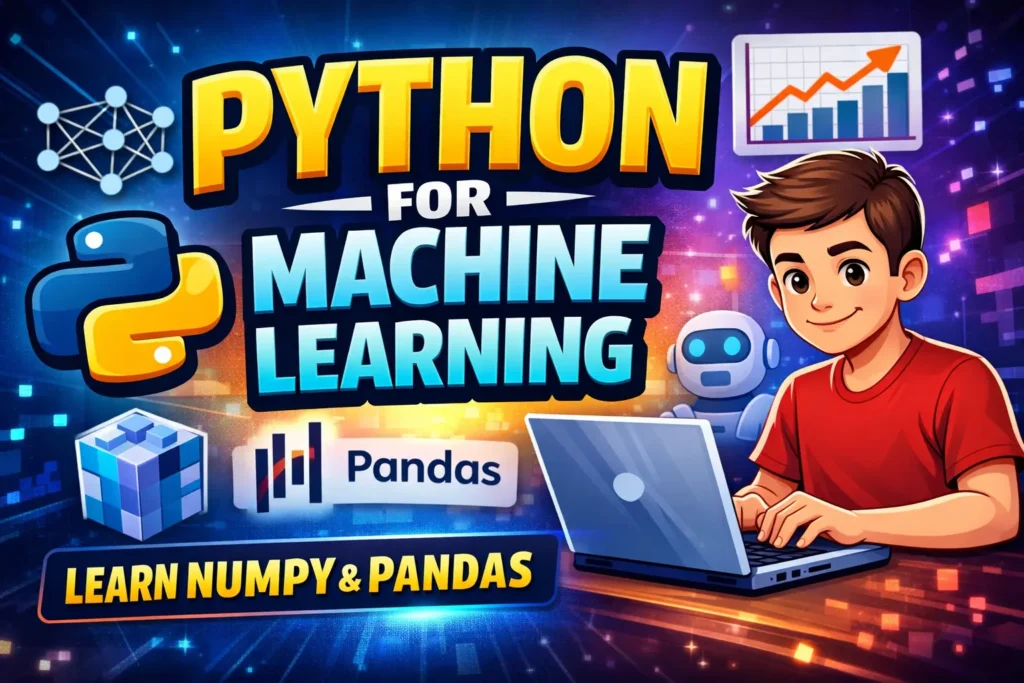
If you want to learn Python for machine learning without paying for a beginner course, the Python for Machine Learning course from Great Learning Academy is a strong option to consider. It is positioned as a free beginner-friendly course that introduces core Python concepts used in machine learning workflows, with major emphasis on NumPy and Pandas.
For many beginners, one of the biggest mistakes is trying to jump directly into machine learning algorithms before understanding the data-handling libraries that power most Python workflows. This course appears to take a better path. It starts with numerical arrays and data manipulation before moving into broader machine learning context.
This article breaks down what the course covers, who it is for, the main skills you will gain, the visible outline, and whether it is worth your time if you are starting your machine learning journey with Python.
- Course: Python for Machine Learning
- Platform: Great Learning Academy
- Level: Beginner
- Duration: 2.25 learning hours
- Rating: 4.51
- Learners: 469.1K+ enrolled
- Instructor: Mr. Bharani Akella
What Is the Python for Machine Learning Course?
The Python for Machine Learning course is a free online beginner program that focuses on the Python elements and features used in machine learning tasks. According to the course page, the first half introduces the NumPy library and helps learners understand arrays, intersections, differences, loading, and saving. The second half focuses on the Pandas library, including objects, dataframes, and functions.
This structure makes sense for beginners. Before you can build serious machine learning projects, you need to know how to work with data in Python. That means handling arrays, performing mathematical operations, storing and loading data, and analyzing tabular information efficiently.
The course also includes a quiz at the end to help learners test their knowledge and work toward certificate completion. For entry-level learners, that adds a useful checkpoint rather than making the course only passive video learning.
Why This Free Python for Machine Learning Course Matters
Python is one of the most important languages in machine learning, data science, and AI. But beginners often feel lost because the ecosystem includes many libraries, concepts, and workflows. A short and structured course like this can help reduce that confusion.
What makes this course useful is that it appears to focus on the foundational libraries that learners need first. NumPy supports numerical computing and array operations. Pandas helps with data manipulation and tabular analysis. Together, they form the base of many real machine learning pipelines.
The course page also frames the program as a beginner’s guide to Python for machine learning, and it connects the content to broader areas like data science, supervised learning, and unsupervised learning. That makes it useful for learners who want both practical tooling and a basic machine learning context.
What You Will Learn
The course page lists several practical skill areas that learners can expect to gain:
- NumPy Arrays
- NumPy Operations
- NumPy Math
- Saving and Loading NumPy
- Pandas Series
- Pandas DataFrame
- Pandas Functions such as mean, median, max, and min
- Data Manipulation
- Supervised Learning
- Unsupervised Learning
- Machine Learning with Python
This is a strong beginner combination because it focuses on the parts of Python that learners actually use when working with datasets. Instead of overwhelming learners with too many advanced ideas at once, the course appears to center on the practical fundamentals needed before moving deeper into machine learning.
Course Highlights
The platform highlights three key benefits of the course:
- Get free course content
- Master in-demand skills and tools
- Test your skills with quizzes
The page also strongly promotes the certificate side of the experience. It describes the certificate as industry-recognized and says more than 10,000 certificates have been claimed. It also highlights benefits such as getting noticed by recruiters, sharing the certificate on professional channels, global recognition, and helping support job opportunities.
For students and job seekers, that certificate positioning can be a useful extra incentive, especially when the course is free and beginner-friendly.
About the Course Content
The published course description says the course focuses on Python programming features used in machine learning tasks and includes demonstrated samples. It explains that the first half covers NumPy and its arrays, intersections, differences, loading, and saving, while the second half covers Pandas, its objects, dataframes, and functions.
The broader page copy also states that the course provides coverage related to Python in the context of data science, machine learning, and AI, while also mentioning supervised and unsupervised learning and practical code examples. That broader framing makes the course sound more expansive, but the clearest visible emphasis from the published outline remains NumPy and Pandas fundamentals.
Full Course Outline Breakdown
The visible course outline is one of the strongest parts of the page because it makes the learning path easy to understand.
1. Intro to NumPy
The course begins with an introduction to the NumPy library. This section explains NumPy as a way to add functions and methods to Python programs without writing everything from scratch.
This is an excellent starting point because NumPy is foundational in numerical computing and is widely used in data science and machine learning workflows.
2. Joining NumPy Arrays
The next section teaches three different ways to join NumPy arrays:
vstackhstackcolumn stack
This is practical for beginners because array manipulation is one of the first data-preparation skills they need to understand.
3. NumPy Intersection and Difference
Another module explains what intersection and difference mean in the context of arrays. It also shows how to extract exact elements by excluding others, using code demonstrations.
This is useful because working with subsets of data is a very common part of data analysis and machine learning preparation.
4. NumPy Array Mathematics
This section demonstrates mathematical operations on arrays such as:
- sum
- increment
- mean
- median
These operations are central to numerical analysis and form a natural bridge into data science work.
5. Saving and Loading NumPy Arrays
The course then explains how to create, store, and load NumPy arrays. This is practical because real-world machine learning workflows often require saving and reusing structured numerical data.
6. Intro to Pandas
After NumPy, the course introduces Pandas for data manipulation and analysis in Python. This is an important transition because many machine learning workflows involve tabular data, and Pandas is one of the main tools used to work with it.
7. Pandas Series Object
The next section covers one-dimensional labeled arrays through the Pandas Series object. It includes importing the Pandas library, creating a series object using inbuilt data types, and working with it through demonstrated code snippets.
8. Intro to Pandas DataFrame
Another section introduces the Pandas DataFrame and includes a sample demonstration. This is one of the most important beginner topics in the course because DataFrames are central to data analysis, preprocessing, and many machine learning workflows.
9. Pandas Functions
The course also covers important Pandas functions such as mean, median, maximum, and minimum. This reinforces descriptive data analysis and helps learners understand how to summarize data effectively before applying models.
Who Should Take This Course?
This course looks especially suitable for:
- Beginners who want to learn Python for machine learning from scratch
- Students starting with NumPy and Pandas
- Aspiring data science and machine learning learners
- Professionals who want a short introductory course
- Job seekers looking for a beginner-level certificate-backed program
Because the course is labeled as beginner level and runs for 2.25 learning hours, it appears best suited for learners who want a solid introduction rather than an advanced deep dive.
Main Strengths of the Course
Beginner-friendly structure
The course begins with foundational Python data libraries instead of overwhelming learners with advanced machine learning theory from the start.
Strong focus on NumPy and Pandas
These are two of the most important libraries for early machine learning work, and the course gives them clear priority.
Short and accessible format
At 2.25 learning hours, the course is compact enough for people who want a quick but structured introduction.
Certificate positioning
The platform strongly promotes the certificate and related recruiter visibility benefits, which may matter to students and job seekers.
Strong learner traction
With a 4.51 rating and 469.1K+ learners, the course clearly has substantial adoption on the platform.
Possible Limitations
The main limitation is likely depth. Since this is a short beginner-level course, it appears best viewed as an introduction rather than a complete machine learning program.
Also, while the broader page copy mentions areas like machine learning, AI, and Python fundamentals in a wider sense, the clearest visible outline is much more focused on NumPy and Pandas. So learners expecting a deep dive into model building or advanced machine learning algorithms will probably need additional study after this course.
Is This Free Python for Machine Learning Course Worth Taking?
Yes, for beginners, it looks worth taking. The course appears to offer a useful mix of practical Python data skills, beginner-friendly structure, strong learner adoption, and certificate-oriented positioning.
If your goal is to build a basic Python foundation for machine learning, especially around data handling, numerical operations, and core library usage, this course looks like a strong free starting point.
Final Verdict
Python for Machine Learning from Great Learning Academy looks like a strong beginner course for learners who want to start with Python-based machine learning foundations for free. It combines NumPy, Pandas, array operations, basic data manipulation, and introductory machine learning context in a short and accessible format.
If your goal is to build a foundation in Python for machine learning without committing to a long or expensive program, this course appears to be a smart first step. It is especially useful for beginners who want a structured learning path, a certificate-oriented experience, and direct exposure to practical Python data workflows.
Frequently Asked Questions
Is this Python for Machine Learning course free?
Yes, it is listed as a free course on Great Learning Academy.
What level is the course?
The course is marked as beginner level.
How long is the course?
The course duration is 2.25 learning hours.
Who teaches the course?
The instructor listed on the page is Mr. Bharani Akella.
What skills does the course cover?
It covers NumPy arrays, NumPy operations, NumPy math, saving and loading NumPy, Pandas Series, Pandas DataFrame, Pandas functions, data manipulation, and introductory machine learning context.
Is this enough to master machine learning?
No. It is best viewed as a beginner-friendly introduction, especially focused on NumPy and Pandas foundations. More advanced study will be needed after this course.
Official course page: Python for Machine Learning