Introduction: This article provides a practical, SEO-friendly overview of Python and its ecosystem for data science, followed by hands-on data handling, visualization, and core machine learning concepts. It outlines key libraries, essential data structures, data I/O and manipulation techniques, statistical foundations, popular algorithms, and what the “Machine Learning & Python Data Science for Business and AI” course delivers for business and AI applications.
Python and Its Ecosystem for Data Science
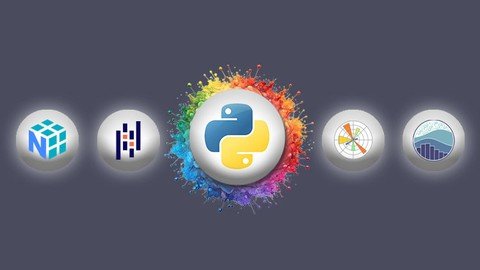
Python is the central tool in this course, supported by a compact ecosystem of libraries designed for efficient data work and machine learning. Key Python libraries covered include:
- NumPy — foundational numerical arrays and operations for fast computation.
- Pandas — high-level data structures and tools for reading, writing and manipulating tabular data.
- Matplotlib — core plotting library for customizable visualizations.
- Seaborn — statistical visualization built on Matplotlib for attractive, informative charts.
- Scikit-Learn — a comprehensive library for implementing and evaluating classic machine learning algorithms.
The course also covers the basic Python data structures necessary to manipulate and store data before modeling:
- Lists — ordered, mutable collections for general-purpose use.
- Tuples — ordered, immutable sequences for fixed collections.
- Dictionaries — key-value mappings ideal for labeled data and lookups.
- Sets — unordered collections of unique elements useful for membership testing.
Working with Data: Reading, Manipulation, Visualization, and Cleaning
Practical data work is the backbone of any data science workflow. This course teaches reading and writing data using Pandas across common formats—CSV, Excel, JSON—and emphasizes clean, reproducible I/O practices.
Data manipulation skills taught include:
- Merging — combining multiple datasets to create comprehensive tables for analysis.
- Filtering — selecting relevant rows and columns to focus on meaningful subsets.
- Sorting — ordering data to reveal trends and prepare for downstream processing.
- Aggregating — grouping and summarizing values to compute totals, averages, and other summaries.
Descriptive statistics form the quantitative foundation for understanding data distributions and variability. The course covers:
- Central tendency: mean, median, and mode to describe typical values.
- Dispersion: variance and standard deviation to quantify spread and variability.
Visualization translates analysis into insight. Using Matplotlib and Seaborn, students learn to create clear charts that communicate findings effectively, supporting data-driven decisions in business contexts.
Handling missing data is addressed with practical strategies such as:
- Imputation — filling missing values using appropriate techniques to retain information.
- Deletion — removing incomplete records when necessary to preserve data quality.
Together, these skills prepare data for modeling: clean, understood, and visualized datasets that lend themselves to reliable machine learning outcomes.
Core Machine Learning Concepts and Algorithms
This course begins with a clear definition: What is Machine Learning? and distinguishes the two primary types—Supervised Learning (learning from labeled examples) and Unsupervised Learning (finding patterns without labels).
An overview of the machine learning landscape and the data pipeline is provided so learners understand each step from data collection through cleaning, feature selection, model training, evaluation, and deployment. The course dives into both theory and practical implementation and evaluation for key algorithms:
- Linear Regression — theory, implementation, and evaluation for continuous prediction problems.
- Logistic Regression — theory, implementation, and evaluation for binary classification tasks.
- K-Nearest Neighbors (KNN) — an intuitive instance-based method for classification and regression.
- K-Means Clustering — unsupervised partitioning of data into clusters, with theory, implementation, and evaluation.
- Hierarchical Clustering — building nested cluster trees to explore structure in data.
Feature selection is emphasized to improve model performance and interpretability. Methods covered include:
- Filter Methods — selecting features based on statistical properties.
- Wrapper Methods — using model performance to evaluate subsets of features.
- Embedded Methods — feature selection that occurs during model training.
Ensemble learning techniques are also included to boost predictive power:
- Bagging — including Random Forests and bootstrap aggregating to reduce variance.
- Boosting — including AdaBoost, Gradient Boosting, and XGBoost to reduce bias and enhance accuracy.
The course introduces neural networks and deep learning as advanced techniques, covering the basic structure of a neural network—neurons, layers, weights, and biases—so students grasp how deep models learn from data.
Course Benefits, Audience, and Practical Outcomes
“Machine Learning & Python Data Science for Business and AI” is a comprehensive, project-based course designed to turn novices into practitioners. It skips heavy academic theory and focuses on practical applications using Python, Pandas, NumPy, Scikit-Learn, Matplotlib, and Seaborn. Students build a portfolio of real-world projects applicable to marketing, finance, sales, and operations, enabling actionable insights and strategic decisions.
Who should enroll:
- Anyone curious about how machine learning works and its impact on business and technology.
- Students and recent graduates building a portfolio to enter the AI industry.
- Business professionals seeking data-driven decision-making skills.
- Developers aiming to expand into data science and AI.
By completion, students will be able to:
- Write Python programs for data analysis and AI, including data collection, cleaning, processing, and visualization.
- Build, evaluate, and improve machine learning models for real business problems.
- Apply feature selection, ensemble methods, and foundational neural network concepts.
- Produce a portfolio of real datasets and projects that demonstrate practical skills to employers.
The course is presented by Brighter Futures Hub on Udemy. With over 17 years of IT experience and a passion for digital education, the instructor focuses on clear, structured, hands-on learning to empower students from diverse backgrounds.
Conclusion: This article summarized Python’s essential role in data science, the practical tools and workflows for reading, cleaning, visualizing, and analyzing data, and a roadmap through core machine learning methods from linear models to ensemble methods and neural networks. Enrolling in the course equips learners with real-world skills, project experience, and the confidence to apply AI and data science in business contexts.