
Introduction
Participate in an individual coding hackathon for data professionals (freshers & experienced) using Zerve. Build and deploy a measurable analytical system that solves a real business problem—examples include churn prediction, demand forecasting, anomaly detection, or a recommendation engine. Your solution must include a model or recommendation engine, validation metrics (backtesting, holdout validation, accuracy metrics or business KPIs), and be shipped to production as an API endpoint or scheduled workflow. Register on Unstop and click “Enter” to sign up on Zerve. Submit your Canvas output and report on Unstop, post a LinkedIn completion screenshot with #ZerveHack and #CreateWithZerve, and upload the LinkedIn post link on Unstop. Use promo code HackathonUnstop to receive 25 free Zerve credits.
What the hackathon requires: solution components and expectations
To compete, deliver a complete, measurable analytical system on Zerve that addresses a concrete business challenge. Your submission must include:
- Model or recommendation engine — the predictive or prescriptive core that solves the selected problem.
- Validation metrics — demonstrate reliability using one or more approaches: backtesting, holdout validation, and clear accuracy metrics or business KPIs.
- Production deployment — ship the solution as an API endpoint or as a scheduled workflow so it can be consumed or automated in real-world operations.
Examples of acceptable problem statements include churn prediction, demand forecasting, anomaly detection, and recommendation engines. Ensure each component is measurable and tied to validation evidence before submission.
Who should participate and choosing your problem focus
This individual coding hackathon is open to both freshers and experienced data professionals. Choose a business problem that fits the required delivery format and validation approaches. When selecting your focus:
- Match the problem to a model or recommendation engine that provides actionable outputs.
- Plan validation using backtesting or holdout validation and define which accuracy metrics or business KPIs will demonstrate success.
- Decide early whether you will deliver your production artifact as an API endpoint or a scheduled workflow so development and deployment follow the same plan.
Registration and submission process
Follow these exact steps to register and submit:
- Registration: register on Unstop and click “Enter” to sign up on Zerve.
- Development: build your analytical system on Zerve, including model/engine, validation, and deployment (API endpoint or scheduled workflow).
- Submission on Unstop: submit your Canvas output and report on Unstop as required by the hackathon.
- Social proof: post a completion screenshot on LinkedIn with the hashtags #ZerveHack and #CreateWithZerve, then upload the LinkedIn post link on Unstop.
- Promo credits: use promo code HackathonUnstop to receive 25 free Zerve credits to support your build on Zerve.
Prizes, access, timeline and deliverable checklist
Prize structure and participant rewards:
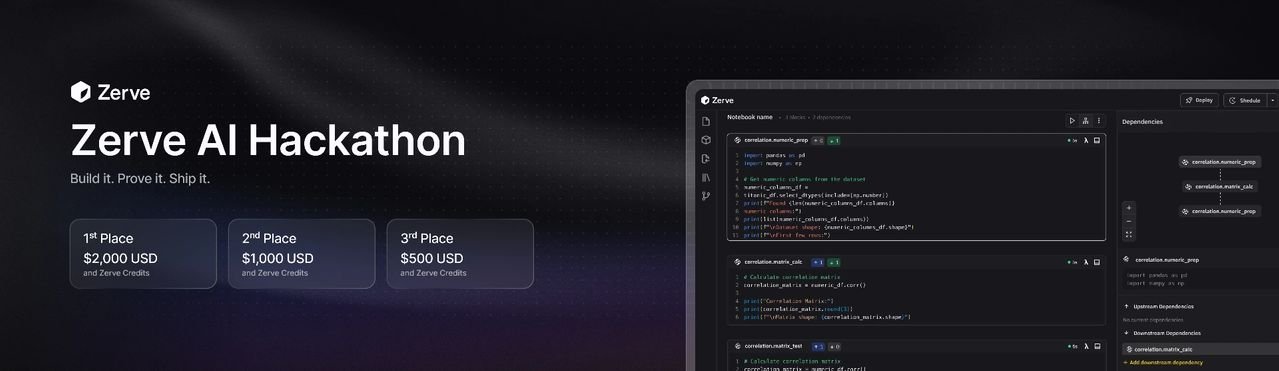
- Monetary prizes: $2,000 for 1st place, $1,000 for 2nd place, $500 for 3rd place.
- Top 10: free Zerve AI access and merch.
- All participants: certificates for all.
Timeline highlights: signup begins 08 Dec 2025; verification and submission stages run through early January 2026.
Final deliverable checklist to upload on Unstop:
- Canvas output
- Project report
- LinkedIn completion screenshot posted with #ZerveHack and #CreateWithZerve
- LinkedIn post link uploaded on Unstop
- Ensure the solution is live as an API endpoint or scheduled workflow on Zerve
Conclusion
This individual coding hackathon on Zerve is a focused opportunity for freshers and experienced data professionals to build, validate, and ship a measurable analytical system that addresses real business problems such as churn prediction, demand forecasting, anomaly detection, or recommendation engines. Follow the registration and submission flow on Unstop, use promo code HackathonUnstop for 25 free Zerve credits, and ensure your deliverables include a model or engine, validation (backtesting, holdout validation, accuracy metrics or business KPIs), and production deployment as an API endpoint or scheduled workflow. With cash prizes, Top 10 rewards, and certificates for all, prepare your Canvas output and report, post your LinkedIn completion screenshot with #ZerveHack and #CreateWithZerve, and upload the link on Unstop before the early January 2026 submission window closes.